The Benefits of Design-Build
Why More Owners Are Choosing Design-Build
If you've ever managed a building project the traditional way, you know the routine: hire an architect, wait months for a finished design, put it out to bid, hope the numbers come back close to budget, then hire a contractor who is seeing the plans for the first time. When something doesn't fit in the field, the phone calls start — and everyone has a reason it isn't their fault.
Design-build takes a different path. One contract. One team of architects, engineers, and builders working together from the first sketch to the final walkthrough. That simple change in structure has a measurable effect on how fast projects finish, how well budgets hold, and how much stress lands on the owner.
It's also why design-build has moved from "alternative" to mainstream. Here's what the national data says — and how Plus One Design & Construction puts it to work for clients across Texas and Louisiana.
1. Faster Project Delivery Without Sacrificing Quality
Time is money in construction — and design-build is built to save both.
In a traditional design-bid-build (DBB) project, each phase waits on the one before it. Design is finished, bid documents go out, contractors price the work, a low bidder is selected, and only then does construction begin. Design-build overlaps those phases. While the design team finalizes interior details, the site can be graded, foundations poured, and long-lead equipment ordered.
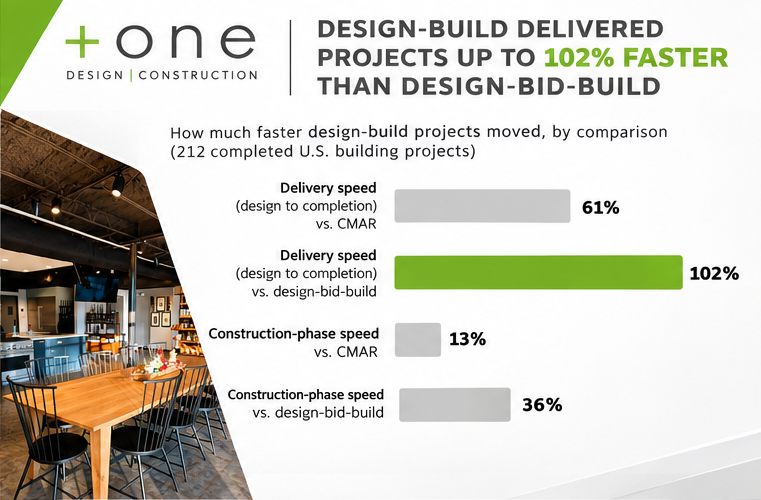
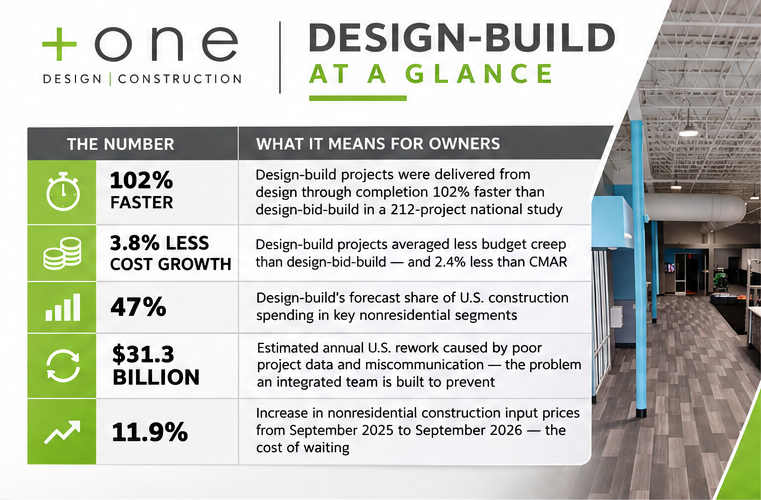
The most widely cited national research backs this up. A Construction Industry Institute (CII) and Charles Pankow Foundation study of 212 completed U.S. building projects found design-build was the best-performing delivery method on every speed measure — 61% faster than construction manager at risk (CMAR) from design through completion, and 102% faster than design-bid-build. Even counting only the construction phase, design-build ran 13% faster than CMAR and 36% faster than DBB.
Where the time savings come from
- No waiting for 100% drawings. Early work packages — site work, foundations, structural steel — can be released as soon as they're ready.
- No separate bid period. Builders price and sequence the work while it's being designed.
- Earlier procurement. Long-lead items like switchgear, rooftop HVAC units, and overhead doors get ordered months sooner
- a big deal while material supply chains remain unsettled.
- Problems caught on paper, not in the field. A clash spotted in design costs an eraser; the same clash found during construction costs days.
- What faster means for you
- Faster occupancy, and earlier revenue for commercial clients
- Less downtime for renovations or expansions of facilities you're already operating
- Less time exposed to rising material and labor prices
At Plus One, we prioritize speed with precision. A compressed timeline never means shortcuts on craftsmanship, code compliance, or quality control.
2. Cost Control and Budget Transparency from Day One
Cost overruns are the number-one worry for most owners — and right now that worry is well-founded. According to the Associated General Contractors of America (AGC), prices for inputs to new nonresidential construction rose 11.9% from September 2025 to September 2026, more than triple the rise in consumer prices, driven by fuel costs and tariff-impacted metals.
In the traditional model, owners often don't learn what their design will actually cost until bids come back — sometimes months after the drawings were finished and prices have moved. If the bids come in high, the project goes back to the drawing board, losing time and money.
Design-build flips that sequence. The budget is set early, and the design is developed to meet it, with the builder estimating continuously as decisions are made.
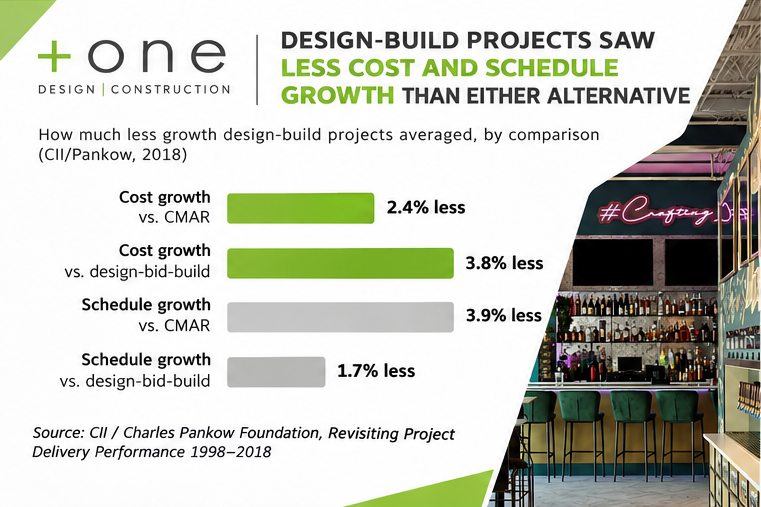
The CII/Pankow research found design-build projects averaged 3.8% less cost growth than design-bid-build and 2.4% less than CMAR. They also came in 1.9% less per square foot than CMAR and 0.3% less than DBB. On a $10 million building, every percentage point of cost growth is $100,000 — money that either stays in your contingency or goes out the door in change orders.
What clients gain
• Real-time cost insight during design — "design to budget" instead of "design, then price"
• Fewer surprises and fewer change orders, because the designer and builder are the same team
• Value engineering while it's still cheap — before drawings are final, not after the steel is ordered
• Honest tradeoff conversations about finishes, systems, and phasing, with real numbers on the table
At Plus One Design & Construction, we emphasize proactive budgeting, so you always know where your investment stands.
3. A Single Point of Accountability (No Finger-Pointing)
In traditional construction, the owner holds separate contracts with the designer and the builder. When a problem shows up in the field — a dimension that doesn't work, ductwork that won't fit above the ceiling — the contractor points at the drawings, the architect points at the contractor, and the owner pays in time, money, or both while it gets sorted out.
That friction is expensive at an industry scale. A survey of nearly 600 construction leaders by FMI and PlanGrid estimated that poor project data and miscommunication drove $31.3 billion in U.S. rework in a single year — roughly half of all rework on U.S. jobsites.
Design-build eliminates the gap where those problems hide.
Why it works:
• One team = one responsible party. Design and construction live under one contract.
• Clear communication channels. Designers and builders talk to each other daily, not through RFIs and formal letters.
• Faster resolution. When an issue comes up, the people who can fix it are already on the same team.
What it means for you
• Less stress and fewer meetings refereeing disputes
• More confidence in outcomes
• A partner who owns the results — good or bad
At Plus One, accountability isn't shared - it's
owned.
4. Collaboration That Drives Better Results
Design-build creates a true team environment, where architects, engineers, and builders sit at the same table from the start. Builders bring real-world knowledge of cost, sequencing, and materials into design conversations; designers bring creativity and code expertise into construction planning.
Here's what that looks like in practice:
Picture a 12,000-square-foot municipal building. On a traditional project, the architect might specify a façade system that looks great on paper but carries a 20-week lead time — and nobody finds out until the contractor is hired. On a design-build team, the builder flags the lead time during schematic design, and the team selects a comparable system that ships in a fraction of the time, before a single drawing has to be redone.
Collaboration leads to:
• Smarter design solutions grounded in what's buildable and affordable
• Improved constructability, with fewer conflicts between architectural, structural, and MEP systems
• Fewer revisions and delays, because coordination happens before construction, not during it
When every stakeholder is aligned early, projects benefit from innovation and efficiency at every stage. Instead of reacting to problems, design-build teams anticipate them and solve them before they happen.
At Plus One Design & Construction, collaboration isn't just part of the process — it's the foundation of it.
5. Reduced Risk and Greater Peace of Mind
Every construction project carries risk: design errors, unforeseen site conditions, price swings, and schedule slips. Design-build doesn't make risk disappear, but it puts that risk where it can be managed best.
Under design-bid-build, the owner generally stands behind the adequacy of the plans it hands to the contractor. That means a design error often becomes an owner-paid change order. Under design-build, design and construction responsibility rests with one entity- so the team that drew it is the team that has to make it work.
The data reflects that reliability. In the CII/Pankow study, design-build projects saw 1.7% less schedule growth than design-bid-build and 3.9% less than CMAR.
How design-build reduces risk
• Risks are managed by one integrated team rather than passed back and forth between separate contracts
• Fewer contracts mean fewer legal complications and fewer opportunities for disputes
• Early planning minimizes costly surprises — site investigations, utility coordination, and permitting are tackled up front
What owners still own
Design-build works best when the owner is clear about goals from the start: program, budget, schedule, and quality expectations. A strong owner's representative and a well-defined scope are the foundation of a successful design-build partnership; and Plus One helps clients build both.
With design-build, you're not managing multiple vendors; you're working with a single, trusted partner. At Plus One, we focus on delivering certainty, not surprises.
Is Design-Build Right for Your Project?
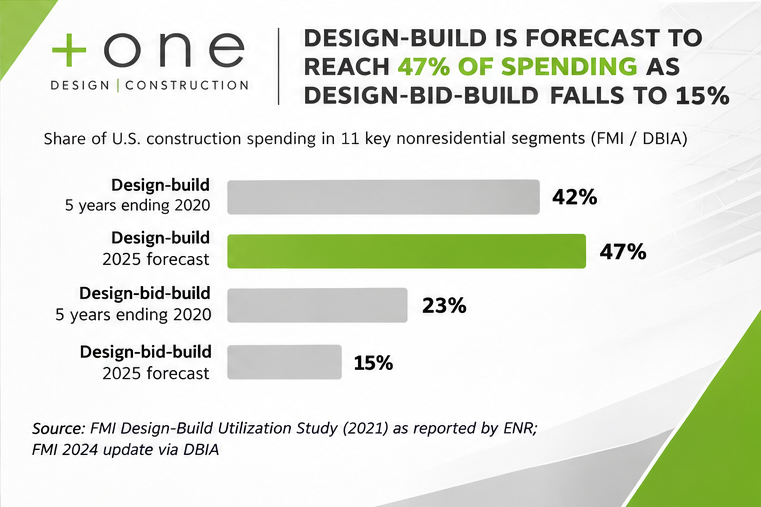
The market has already answered the bigger question. FMI's research for the Design-Build Institute of America found design-build's share of spending in key nonresidential segments climbing from 42% to a forecast 47%, while traditional design-bid-build drops from 23% to 15%. FMI's latest update projects design-build will represent more than 47% of U.S. construction spending by 2028 — over $1.1 trillion across five years.
What it means here in Texas and Louisiana:
• Texas is growing fast- and needs to build fast. Texas added more than 391,000 residents between July 2024 and July 2025. The Houston and Dallas–Fort Worth metros posted the two largest numeric gains in the nation, and the five fastest-growing U.S. cities of 20,000+ were all Texas suburbs. Chapter 2269 of the Texas Government Code lets governmental entities choose design-build, CMAR, and other alternative delivery methods — giving cities, counties, and school districts room to move at the speed of growth.
• Louisiana has its own rules. Louisiana's Public Bid Law generally prohibits public entities from using design-build unless a statute specifically authorizes it, so public owners often turn to construction management at risk (CMAR), which is permitted for projects estimated at $5 million or more. Private owners in Louisiana can use design-build freely. Plus One helps clients identify the best delivery method the law allows.
Design-build is a strong fit when:
• Your schedule is tight or occupancy dates are fixed
• Your budget is set by a bond issue, grant, or lender and can't move
• The building is technically complex and needs tight coordination between disciplines
• You want one point of contact and one partner accountable for results
Consider other methods when:
• You want complete control over every design detail before any pricing occurs
• The project is very simple and fully designed already
• State or local law requires low-bid procurement for your project type
Let's Build Smarter...Together
Design-build isn't just a contract structure; it's a better way to work. Faster delivery, budget transparency, one accountable partner, real collaboration, and less risk all come from the same simple idea: put the people who design the building and the people who build it on the same team from day one.
That's how Plus One Design & Construction has worked from the beginning — with architecture and construction under one roof and offices serving clients across Texas and Louisiana.
Planning a project?
Let's talk about schedule, budget, and the delivery method that fits. Visit us
here to schedule a no-obligation project consultation.